
The Minimum Effective Training Dose for Muscle Preservation on GLP-1
TL;DR
- The minimum effective training dose on GLP-1 is lower than most gym programming implies: roughly 4–8 hard sets per muscle group per week.
- The deficit lowers your ceiling for building muscle. It does not raise the floor for keeping it — and the floor is what you’re managing on GLP-1.
- Set quality outranks set count. Two sets taken close to failure beat four sets you coasted through, and the research on effort backs that directly.
- The floor only works if two things are in place: enough protein to signal “keep this tissue,” and enough effort per set to earn the signal.
- This is the preservation target, not a hypertrophy-maximizing target. Knowing the difference is what keeps you from either overtraining on low calories or quitting because the gym feels pointless.
You’re already training, or you were before appetite dropped off. The question is not whether to lift on GLP-1. It is how little training you can do and still keep the muscle you have. The honest answer is smaller than most people expect: the minimum effective training dose for GLP-1 muscle preservation is low, as long as the work is hard and protein is handled.
Why your training goal shifts from building to preserving
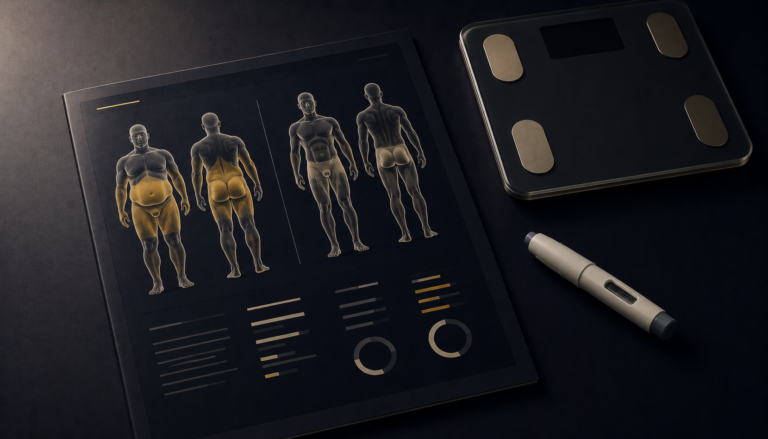
On a normal training phase, you eat at maintenance or a surplus, and the job is to add tissue. On GLP-1, you’re in a sustained caloric deficit by design — the drug suppresses appetite, intake falls, and the body taps stored energy. In that state, building meaningful new muscle is hard for most people, because growth needs an energy surplus the deficit removes.
What does not require a surplus is keeping what you already built. Muscle responds to mechanical tension. When you load a muscle hard enough, often enough, the body reads that as “this tissue is still needed” and holds onto it even while fat is dropping. That’s the entire game on GLP-1: send the retention signal, keep sending it, and let the drug handle the fat.
This matters because of where the lean mass goes if you don’t. Across a pooled analysis of 22 randomized trials and 2,258 participants, roughly 25% of the total weight lost on GLP-1 medications came from lean mass rather than fat (Karakasis et al., Metabolism, 2025;164:156113). A quarter of your loss leaving as muscle is the default outcome. Resistance training is the main thing that bends that number in your favor.
Download the free GLP-1 Starter Framework, the three-lever system for losing fat without losing muscle.
The deficit changes the ceiling, not the floor
Think of it as two separate numbers. The ceiling is how much muscle you could add — and the deficit drops that close to zero for most people. The floor is how much stimulus you need to keep what’s there — and that number barely moves whether you’re cutting or not. People on GLP-1 get this backwards. They assume low energy means they need to train harder and longer to “fight” the loss. The opposite is true. You need to train precisely, not more.
What the Research Says About Minimum Training for GLP-1 Muscle Preservation
Volume — total hard sets per muscle group per week — is the variable most strongly tied to how much muscle you build. The relationship is a dose-response curve: more sets produce more growth, up to a point of diminishing returns (Schoenfeld et al., J Sports Sci, 2017;35:1073-1082). The number you usually see quoted from that line of research — around 10 or more sets per muscle group per week — is a target for maximizing growth.
Preservation sits much lower on the same curve. The first few hard sets capture most of the signal; each additional set adds less. For a lean mass preservation goal in a deficit, the working range is roughly 4–8 hard sets per muscle group per week. That is substantially less than what a typical hypertrophy program prescribes, and for your goal, it’s enough.
The Schoenfeld 2017 dose-response curve
The shape of the curve is the part worth internalizing. It rises steeply at first, then flattens. Going from zero sets to a few hard sets is an enormous jump in stimulus. Going from eight sets to twelve is a small one — and on low calories, those extra four sets cost recovery you can’t spare. You’re trying to live on the steep early part of the curve and ignore the flat tail.
Why 2 hard sets is enough when you’re close to failure
If you hit a muscle group across two exercises at two hard sets each, twice a week, that’s eight sets — the top of the preservation range. Run it once a week and you’re at four, the bottom. Both work. What makes two sets per exercise sufficient is the word hard: a set taken near the point where the next rep would fail recruits the high-threshold motor units that drive the adaptation. A set left well short of that doesn’t.
The proximity-to-failure modifier — why set quality matters more than set count
Sets performed within about 0–3 reps of failure produce a comparable growth stimulus to sets taken all the way to failure; sets left with five or more reps in the tank fall off sharply (Schoenfeld & Grgic, Strength Cond J, 2019;41:108-113). This is the lever you actually control on GLP-1. You can’t easily add calories to support more volume, but you can decide that every set you do is a hard one. Effort is free. Recovery from junk volume is not.
What “minimum effective” looks like in practice
4–8 working sets per muscle group per week
Set the dial by tolerability. A good week, you’re at the top of the range. A nausea week or a dose-escalation week, you drop toward the bottom and stay there until you feel human again. Both ends preserve muscle. The range exists so you can adjust without feeling like you’ve fallen off the program.
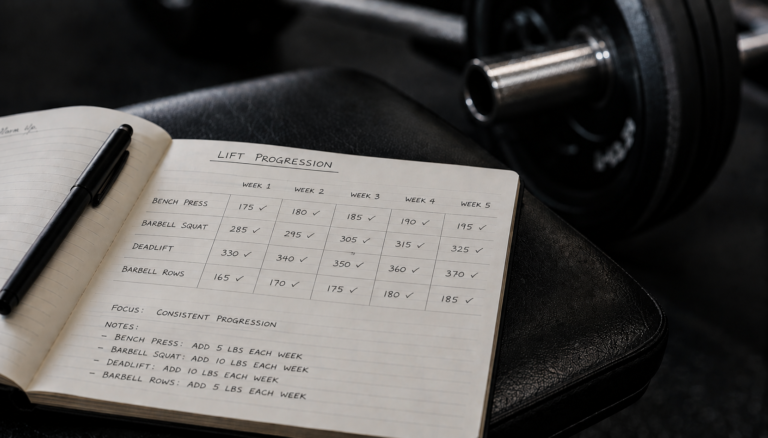
During the 41-week cut, I treated the reduced-volume version as a floor instead of a failed week. If energy or schedule pressure made the full session unrealistic, I cut back to 2 hard sets per exercise and protected the movement patterns. The point was not to prove I could suffer through a bad day. The point was to keep the retention signal alive without letting one compromised session turn into a missed week.
Going in, the target was preservation. I’d built the protocol around the evidence that 4–8 working sets per muscle group per week was the threshold for maintaining lean mass in a caloric deficit, and I set my expectations accordingly: hold what I have, nothing more. I’d run programs with significantly higher volume in earlier in life and every time I combined that volume with a caloric deficit, strength declined. It was consistent enough that I’d stopped expecting deficit training to produce anything other than a managed retreat.
This protocol produced the opposite result. Volume was lower than anything I’d run in a deficit before, and strength kept moving. The minimum effective dose, it turned out, was more effective than I’d expected. I hadn’t planned for gains. I’d planned for preservation. The gains were a consequence of getting the variables right.
The 2-set-per-exercise framework
Pick one or two exercises per muscle group. Do two hard sets each. That’s the unit. It keeps sessions short and forces you to make each set count, because there’s no third set to hide a bad one in. Most people, given four sets, sandbag the first two. Given two, they bring effort to both.
What sessions should look like (time, exercises, effort)
A session is 35–45 minutes: a couple of compound movements, a couple of accessories, two hard sets each, longer rest between sets than you’d take on full energy. You are not chasing a pump or a “destroyed” feeling. You’re checking boxes: tension delivered, signal sent, out the door before fatigue eats the rest of your day.
The two things that make minimum effective volume work
Low volume only preserves muscle when it’s surrounded by the right conditions. Two of them matter.
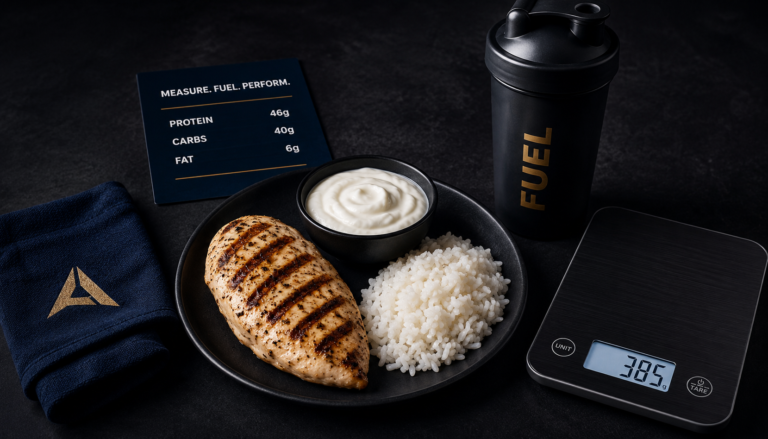
First, protein. The training tells the body to keep the tissue; protein gives it the raw material and the anabolic signal the drug doesn’t provide. The range that protects lean mass in a deficit is about 1.6–2.0 g per kg of body weight (Morton et al., Br J Sports Med, 2018;52:376-384). Miss this and no amount of training rescues the outcome.
Second, effort. The whole case for low volume rests on every set being a hard set. The moment your two sets become two easy sets, the floor stops being a floor — it’s just a small amount of ineffective work. Quality is the non-negotiable that buys you the right to do less.
The bottom line
The minimum training GLP-1 muscle preservation requires is a few hard sets per muscle group, a couple of times a week, with protein handled. That’s it. The fear that you need to grind through long sessions on low energy is the thing that makes people quit — and quitting is the only version of this that reliably costs you muscle. Do less, but do it hard, and feed it.
If you want the full picture of how training fits with the other two levers, the complete strength training guide for GLP-1 users lays out the whole protocol. The companion piece on why training near failure matters more than set count goes deeper on the effort side. For why this all sits inside a bigger system, see the three variables that decide fat versus muscle loss and whether Ozempic actually causes muscle loss.
Download the free GLP-1 Starter Framework — the three-lever system for losing fat without losing muscle.
The GLP-1 Training Protocol ($27) has the full PPL program with both schedule variants, progression rules, GLP-1-specific modifications, and a pre-built Training Tracker spreadsheet.
FAQ
What is the minimum training for GLP-1 muscle preservation?
For preservation in a deficit, roughly 4–8 hard sets per muscle group per week is the working range — well below the 10-plus sets typically prescribed for maximizing growth. The reason it works is that the early part of the volume dose-response curve delivers most of the stimulus; sets beyond that add little while costing recovery you don’t have on low calories. Bias toward the top of the range on good weeks, the bottom on rough ones.
Can I keep muscle with just two workouts a week on GLP-1?
Yes, if those two sessions are full-body and the sets are hard. Two full-body sessions covering a push, a pull, and a lower-body movement at two sets each puts most muscle groups at the bottom of the preservation range. It’s the floor, not the optimum — but the floor genuinely holds muscle, which is the point. A short hard week beats a skipped one every time.
Is two sets per exercise really enough to preserve muscle?
Two sets is enough when both are taken within a few reps of failure. The stimulus comes from recruiting high-threshold motor units, which only happens near failure (Schoenfeld & Grgic, 2019). A third or fourth easy set adds fatigue without adding much signal. Given only two sets, most people also bring more effort to each, which is exactly what makes the low dose work.
Will I lose muscle if I train less on a nausea week?
Not from a single low week. Measurable muscle loss comes from extended inactivity, not from one reduced week. Dropping to the bottom of the volume range — or to the floor protocol — during a bad stretch preserves the training signal and keeps you in the habit. The real risk is stopping entirely and not restarting, which is a different problem than training light for a week.
Does minimum effective volume mean I’ll stop making progress?
On GLP-1 in an active deficit, you probably weren’t going to add much muscle regardless — the deficit caps that. Minimum effective volume isn’t sacrificing progress you’d otherwise have; it’s matching your training to what low calories can actually support. When you reach goal weight and eat more, you raise the volume and chase growth again. During the cut, holding what you have is the win.
Nothing on this site constitutes medical advice. I’m not a physician, and this blog documents my own research and experience. Consult a qualified healthcare provider for decisions about medication, dosing, or treatment.
— Ryan Mercer | MetabolicMale.com | ryanmercer@metabolicmale.com
References
- Karakasis P, Patoulias D, Fragakis N, Mantzoros CS. Effect of glucagon-like peptide-1 receptor agonists and co-agonists on body composition: systematic review and network meta-analysis. Metabolism. 2025;164:156113. https://doi.org/10.1016/j.metabol.2024.156113
- Schoenfeld BJ, Ogborn D, Krieger JW. Dose-response relationship between weekly resistance training volume and increases in muscle mass: a systematic review and meta-analysis. J Sports Sci. 2017;35(11):1073-1082. https://doi.org/10.1080/02640414.2016.1210197
- Schoenfeld BJ, Grgic J. Does training to failure maximize muscle hypertrophy? Strength Cond J. 2019;41(5):108-113. https://doi.org/10.1519/SSC.0000000000000473
- Morton RW, et al. A systematic review, meta-analysis and meta-regression of the effect of protein supplementation on resistance training-induced gains in muscle mass and strength in healthy adults. Br J Sports Med. 2018;52(6):376-384. https://doi.org/10.1136/bjsports-2017-097608