Building Your Training Schedule Around Injection Day
TL;DR
- Your training schedule around injection day is worth setting deliberately. The nausea window is predictable enough that you can place the roughest stretch on days with the least to lose.
- Side effects tend to peak roughly 12–72 hours after the shot, then ease. Build rest and lighter days into that window; put your hardest sessions in the clear stretch that follows.
- The most reliable setup: inject on a rest day that is also a day off work, followed by another rest day. The window has nowhere to be.
- Map your own peak window over the first few titration weeks because timing varies by person and by dose, and the average is a starting point, not your number.
- When a session within your schedule falls on a genuinely rough day, switch to the floor protocol for that session. You don’t skip; you modify.
Your training schedule around injection day does not have to be solved through trial and error. The nausea window often follows a weekly pattern, which means you can plan around it from the start. This is one of the few setup decisions that can remove a meaningful variable from the side-effect problem before it starts.
The Nausea Window You’re Scheduling Around
Peak onset: 12–72 hours post-injection for most users
GLP-1 medications are dosed once weekly, and the agonist stays active across the full week, semaglutide’s half-life runs about a week per FDA prescribing information, which is why a single weekly injection covers the dosing window. The side effects don’t spread evenly across those seven days. For most users they cluster in a window roughly 12 to 72 hours after the shot: nausea climbs, appetite craters, energy dips. Then the window passes and the back half of the week feels comparatively clear.
Why it varies by person and dose
The 12–72 hour window is a center of mass, not a rule. Some people feel it within hours of injecting; others not until day two. The window tends to widen and intensify when you step up a dose, then compress again as the body adapts to the new level. Your job is to find your version of the window, not to assume the average is yours.
How to map your personal window
For the first two to three weeks, log it. Note your injection time and rate nausea and energy each day until the next shot. Within a few weeks a pattern appears: a consistent stretch where training would be miserable and a consistent stretch where you feel capable. That pattern is what the schedule gets built on. Without it you’re placing rest days by guesswork.
Download the free GLP-1 Starter Framework, the three-lever system for losing fat without losing muscle.
Building Your Training Schedule Around Injection Day
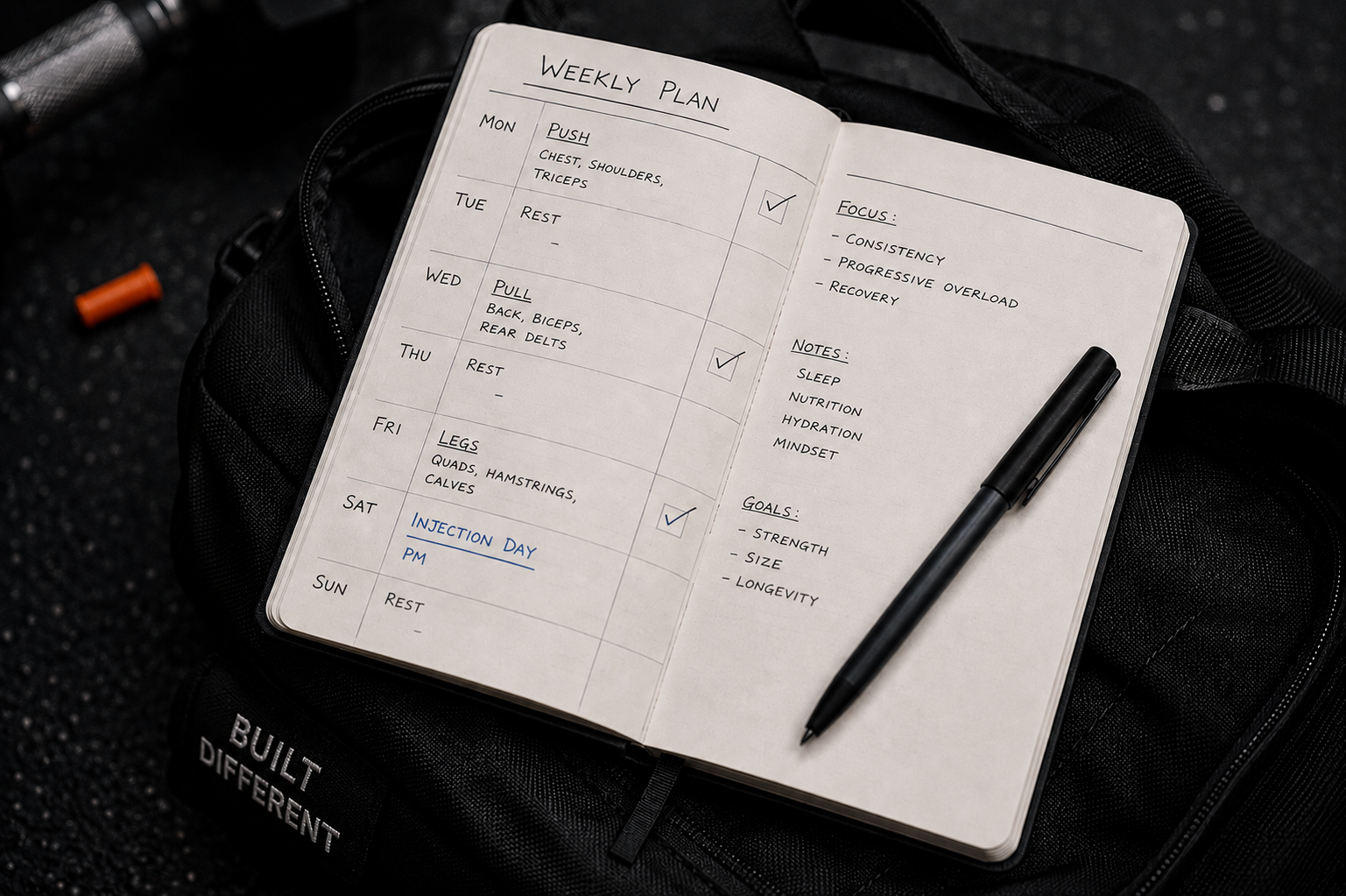
I trained Monday, Wednesday, and Friday, and I injected on Saturday. That timing was deliberate. Saturday was already a rest day, and it was followed by another rest day on Sunday.
Saturday is already a rest day, so there’s no training session to lose or reschedule. It’s a day off work, so if side effects hit harder than expected, there’s no performance demand to manage through. And it’s followed by Sunday — another rest day and another day off — which means the 24–72 hour post-injection window falls entirely across two days where flexibility is complete. The injection goes in on a day with the least to lose, and the recovery window has nowhere to be.
Monday, Wednesday, and Friday are then all in the clear stretch. Each session falls after the window has passed, with energy and tolerability at their weekly high. The structure didn’t require any compromise — the training days were protected by default because the injection day was chosen to protect them.
Most people pick their injection day based on habit or convenience. Structuring that decision around your training week and your work schedule removes a meaningful variable from the nausea management problem before it starts.
The underlying principle
The principle generalizes beyond any specific schedule: inject on a rest day that is also a low-obligation day, and arrange for the 24–72 hour window to fall on days where compromised energy has the least cost. For someone who trains Tuesday, Thursday, Saturday, a Sunday or Monday injection achieves the same setup. The specific days don’t matter; the logic does.
If your work schedule doesn’t give you two consecutive rest days
If you can’t arrange two consecutive rest days to absorb the window, priority-rank your training days and inject before the lowest-priority one. If Thursday is your lightest session and Friday is legs — your most demanding day — inject Wednesday night so the window runs Thursday into Friday morning and has mostly cleared before legs. Not ideal, but better than randomly placed.
When the Schedule Gets Disrupted Anyway
Train before injecting if a session falls on injection day
If your schedule forces a training session onto the same day as the injection, train first and inject after. At the end of the previous week’s cycle you’re at your most recovered and least nauseous point. Injecting after the session means the window opens once the work is already banked.
Dose escalation and the floor protocol
When you step up a dose, the window sometimes widens to cover days it doesn’t normally reach. On any day where the window genuinely impairs a session, switch to the floor protocol for that session rather than skipping it: the three primary movements, two hard sets each, exercise substitutions where needed to keep intra-abdominal pressure low. One compromised session handled as a floor session keeps the signal alive and keeps the habit intact.
Session Modifications for High-Nausea Days
Exercise substitutions
Bracing hard and bending over both aggravate nausea. On a rough day, swap the high-pressure movements: a leg press for a back squat, a chest-supported or cable row for a bent-over row, a machine press for a standing barbell press. Same muscles, same stimulus, significantly less of the positioning that makes a queasy session worse.
Rest period adjustments
Extend your rest between sets on high-nausea days rather than dropping the load or the effort. Longer rest lets you still reach near-failure, the quality that produces the retention signal without the back-to-back pace that stacks fatigue on top of nausea. The session takes a few extra minutes; the sets stay productive.
The Bottom Line
Your training schedule for injection day is one scheduling decision that pays a full week of dividends, every week. Inject on the day with the least to lose; a rest day, a day off work, ideally followed by another rest day and the 24–72 hour window falls on days where it can run its course without disrupting anything. Stack your hardest sessions in the clear stretch that follows. Map your personal window over the first few weeks before committing to a structure. And on the days the window reaches a scheduled session anyway, the floor protocol keeps the week intact.
For what to run on a floor session, see the GLP-1 training floor, and for the nutrition side of a nausea day, what to eat for Ozempic nausea. The full strength training guide for GLP-1 users shows how scheduling fits the larger protocol.
Download the free GLP-1 Starter Framework — the three-lever system for losing fat without losing muscle. ryanmercer.gumroad.com/l/txhvrr
The GLP-1 Training Protocol ($27) has the full PPL program with both schedule variants, progression rules, GLP-1-specific modifications, and a pre-built Training Tracker spreadsheet. ryanmercer.gumroad.com/l/pxnnup
FAQ
How do I build a training schedule around my GLP-1 injection day?
Inject on a rest day that is also a day off work, and arrange for the 24–72 hour post-injection window to fall across days where the energy cost has nowhere to land. If you train Monday, Wednesday, and Friday, a Saturday injection keeps the entire window on the weekend. The hard sessions go in the clear stretch that follows the window, not in the middle of it.
Should I work out on the day I take my semaglutide injection?
Most people do better treating injection day as a rest day. If your schedule forces a session onto injection day, train before you inject so you’re at the tail end of the previous week’s cycle at that point, which is typically your most recovered and least nauseous state. Injecting after the session means the window opens once the work is already done.
When is the best time to train on GLP-1?
In the clear stretch after the post-injection window passes, typically days three through seven of the week for most users. Nausea and low energy cluster in the first 24–72 hours after the shot, then ease. Stacking your hardest sessions in the back half of the week and protecting them with rest or light days during the rough stretch gives your best energy to the work that matters most.
How long does nausea last after a semaglutide injection?
For most users the worst of it falls in a window roughly 12 to 72 hours after the shot, then eases. The window tends to widen and intensify right after a dose increase, then settle as the body adapts. The timing varies enough by person that tracking nausea day by day for the first few weeks is the only reliable way to know your own pattern.
What do I do when a bad side-effect day falls on a training day?
Run the floor protocol instead of skipping: one squat or hinge, one press, one row, two hard sets each, with machine and supported variations that reduce intra-abdominal pressure. Lengthen rest periods so you can still bring effort to each set without the back-to-back pace making nausea worse. A short honest session beats a skipped one, and the floor protocol is exactly what it’s built for.
Nothing on this site constitutes medical advice. I’m not a physician, and this blog documents my own research and experience. Consult a qualified healthcare provider for decisions about medication, dosing, or treatment.
— Ryan Mercer | MetabolicMale.com | ryanmercer@metabolicmale.com
References
- Novo Nordisk. Ozempic® (semaglutide) injection: U.S. prescribing information. Plainsboro, NJ: Novo Nordisk Inc. [CONFIRM current label revision date and link before publishing; cited for the ~1-week elimination half-life and weekly dosing.]